Featured Media
What is the meaning behind the “memorial of blowing of trumpets” commanded in Leviticus 23? This episode examines how God’s seven annual Holy Days reveal the progression of His plan for humanity. Drawing on passages from the Old and New Testaments, it connects trumpet blasts to warning, warfare, repentance, the enthronement of a king, and the resurrection of the saints. Discover why the Feast of Trumpets prophetically points toward the return of Jesus Christ and the establishment of God’s Kingdom on Earth.
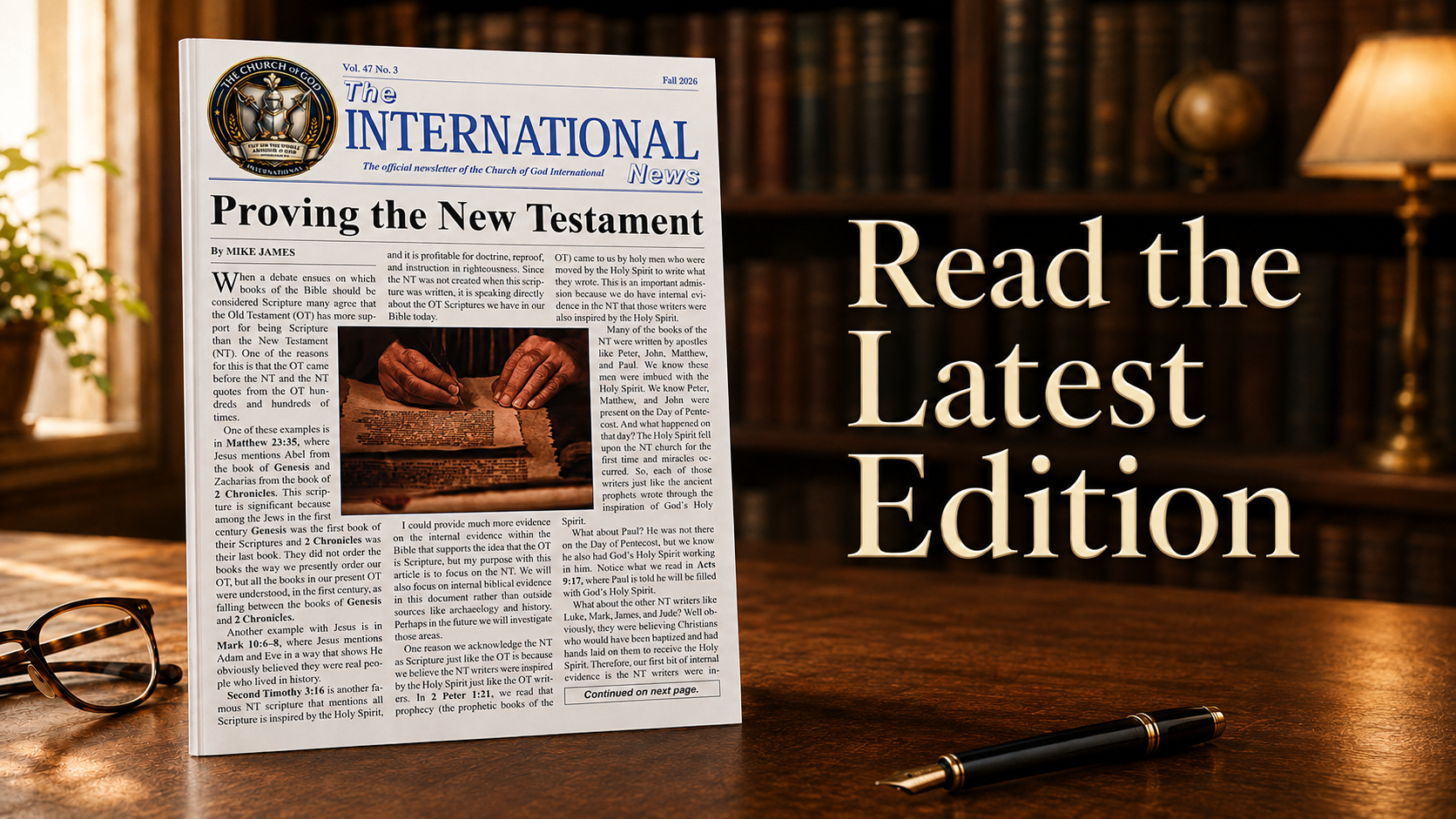
Explore the Fall 2026 edition of The International News, featuring biblical teaching, thoughtful apologetics, and encouraging Church updates.
📖 “Proving the New Testament” – Internal biblical evidence demonstrating why the New Testament should be accepted as the inspired Word of God
🏛️ “Did Early Christian Teachings Borrow from Paganism?” – Examining claims that the accounts of Jesus and central Christian teachings originated in pagan religions
⛓️ “Does the Bible Support Slavery?” – Placing difficult biblical passages in their historical and scriptural context
🌍 Church Updates – Fellowship from the Auburndale congregation and a joyful new addition to the Barnes family
Is the God of the Bible a “moral monster,” as some critics claim? Jeff Reed and Mike James examine ten difficult biblical passages involving the Flood, war, slavery, innocent deaths, and the lake of fire. They explain how historical context, God’s authority, and the promise of a second resurrection shape the Church of God International’s understanding of these accounts. Their discussion presents a message of justice and hope: death is not the end of God’s plan, and everyone will receive a genuine opportunity to know God and choose life.
What does it mean to pray with power, and are we praying the way Jesus taught? Jeff and Mike welcome Timothy Maggenti, author of Unlocking Prayer’s Power, to explain the PRAISED method—a simple biblical framework for meaningful prayer. They discuss vain repetition, prayer routines, interceding for others, unanswered prayers, fasting, and what it means to pray without ceasing. Discover how prayer can become an honest, lifelong conversation that strengthens your relationship with God.
Featured Articles
The Church of God International (CGI) traces its origins to the Church that Jesus founded in the early first century. Membership in the CGI consists of "called out ones" from around the world practicing Christianity as initiated by Jesus and furthered by the early apostles. The church begun by Jesus, the very one He promised would survive through the centuries, is alive and well. Today, disciples live the faith "once delivered to the saints" in this twenty-first century (Jude 3). They obey the same message taught by Jesus Christ, and they proclaim the same gospel taken to the world by the disciples. Members value the witness and teachings of Jesus Christ as the church's work.
The CGI home office is in Tyler, Texas. Incorporated in 1978, CGI has ministers and congregations scattered throughout the United States and Canada . We also have churches in Kenya, Jamaica, the Philippines, Australia, the United Kingdom and a growing number of countries around the world.
The CGI shares many foundational beliefs with other Sabbath-keeping Churches of God, while holding several important doctrinal and organizational distinctions. These include our understanding of the timing of the Passover and Exodus, our rejection of the church-era theory, date-setting, and “headline theology,” and our commitment to accountable servant leadership rather than authoritarian, top-down government. [Learn more about CGI’s doctrinal distinctions here.]
There are many ideas and techniques used to promote the gospel message. Podcasts, videos, TikTok, pamphlets, booklets, sermons, and more. One-on-one evangelism can be very fruitful, too. In a book I am presently reading dealing with change, I have come upon a concept that is important for us to understand in relation to evangelizing one-on-one.
This blog idea comes from Jonah Berger's book The Catalyst: How to Change Anyone's Mind. Berger addresses six major points to keep in mind when trying to change people's minds on something. One of these points addresses "reactance." Let's understand that.